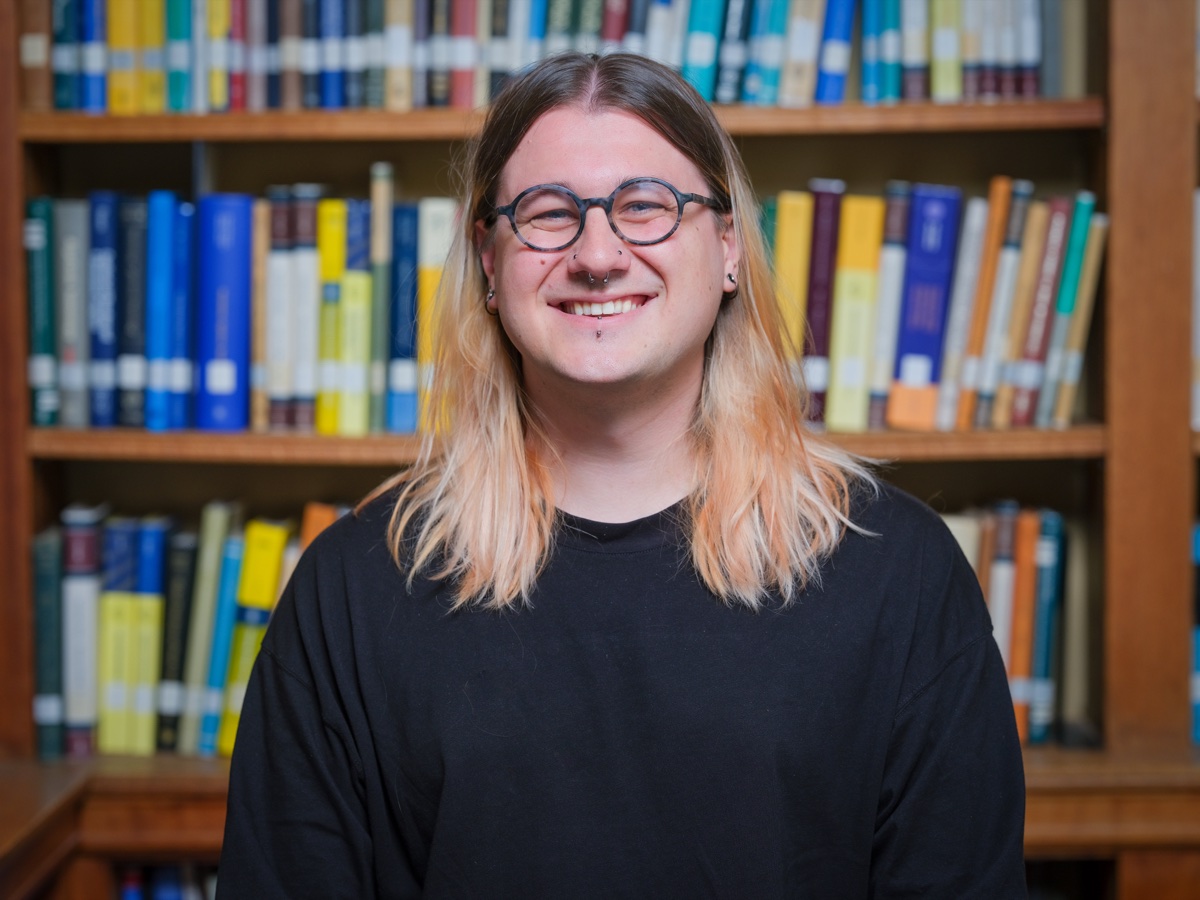
Portrait of Sal Pace

Sal Pace

Final-year physics PhD candidate at MIT
Incoming postdoc at the Institute for Advanced Study in Princeton (Fall 2026)

I’m a theoretical physicist researching the laws of physics that govern large collections of quantum particles. When many particles come together, unexpected quantum phenomena and mathematical structures arise. My research aims to uncover and understand these emergent features.

Technical Overview of Research

I am interested in quantum lattice models (QLMs) and quantum field theories (QFTs), their relations, and their applications to condensed matter physics. The primary themes running through my current work are symmetries, anomalies, and their generalizations. I have been exploring these in two related topics. The first is understanding the structural aspects of QLMs and QFTs, and how they relate to one another. This is a first step toward the larger goal of mapping out and comparing the vast landscapes of these two frameworks. The second is characterizing and classifying phases of quantum matter. This includes gapped phases—both within and beyond topological phases—as well as gapless phases.

I investigate research questions through an interdisciplinary lens, drawing on ideas from condensed matter theory, high‑energy theory, quantum information, and mathematics. Some specific problems I am thinking about and am working on are:

Currently

  • Lieb–Schultz–Mattis theorems from modulated symmetries
  • Anomalies of Onsager symmetries and their anomaly matching conditions
  • Higher‑group symmetries in quantum lattice models
  • Topological melting of quantum crystals and nematics
  • The Symmetry Topological Field Theory (SymTFT)

More broadly

  • Topological phases of matter and topological quantum field theory
  • ’t Hooft anomalies, Lieb–Schultz–Mattis theorems, and their relations
  • Generalized symmetries and gauging in quantum lattice models
  • Family anomalies and generalized Thouless pumps in parametrized quantum systems
  • Foliated field theories, tensor gauge theories, and applications to elasticity and quantum melting
  • Quantum spin liquids and frustrated magnets
  • Applications of category and homotopy theory to physics
  • Applications of quantum information theory to quantum many‑body systems

Scientific papers

  1. [18] Symmetry-enforced Fermi surfaces
    Minho Luke Kim, SP, and Shu-Heng Shao
  2. [17] Spacetime symmetry-enriched SymTFT: from LSM anomalies to modulated symmetries and beyond
    SP, Ömer M. Aksoy, and Ho Tat Lam
  3. [16] Parity Anomaly from a Lieb-Schultz-Mattis Theorem: Exact Valley Symmetries on the Lattice
    SP, Minho Luke Kim, Arkya Chatterjee, and Shu-Heng Shao
  4. [15] Lattice T-duality from non-invertible symmetries in quantum spin chains
    SP, Arkya Chatterjee, and Shu-Heng Shao
  5. [14] (SPT-)LSM theorems from projective non-invertible symmetries
    SP, Ho Tat Lam, and Ömer M. Aksoy
  6. [13] Quantized axial charge of staggered fermions and the chiral anomaly
    Arkya Chatterjee, SP, and Shu-Heng Shao
  7. [12] Gauging modulated symmetries: Kramers-Wannier dualities and non-invertible reflections
    SP, Guilherme Delfino, Ho Tat Lam, and Ömer M. Aksoy
  8. [11] Topological aspects of brane fields: Solitons and higher-form symmetries
    SP and Yu Leon Liu
  9. [10] Generalized symmetries in singularity-free nonlinear σ models and their disordered phases
    SP, Chenchang Zhu, Agnès Beaudry, and Xiao-Gang Wen
  10. [9] Emergent generalized symmetries in ordered phases and applications to quantum disordering
    SP
  11. [8] Exact emergent higher-form symmetries in bosonic lattice models
    SP and Xiao-Gang Wen
  12. [7] Aspects of ℤN rank-2 gauge theory in (2 + 1) dimensions: Construction schemes, holonomies, and sublattice one-form symmetries
    Yun-Tak Oh, SP, Jung Hoon Han, Yizhi You, and Hyun-Yong Lee
  13. [6] Emergent higher-symmetry protected topological orders in the confined phase of U(1) gauge theory
    SP and Xiao-Gang Wen
  14. [5] Position-dependent excitations and UV/IR mixing in the ℤN rank-2 toric code and its low-energy effective field theory
    SP and Xiao-Gang Wen
  15. [4] Dynamical Axions in U(1) Quantum Spin Liquids
    SP, Claudio Castelnovo, and Chris R. Laumann
  16. [3] Emergent Fine Structure Constant of Quantum Spin Ice Is Large
    SP, Siddhardh C. Morampudi, Roderich Moessner, and Chris R. Laumann
  17. [2] The β Fermi-Pasta-Ulam-Tsingou Recurrence Problem
    SP, Kevin A. Reiss, and David K. Campbell
  18. [1] Behavior and breakdown of higher-order Fermi-Pasta-Ulam-Tsingou recurrences
    SP and David K. Campbell

Invited talks

  • Institute for Advanced Study
    Jan ’26
  • University of Oxford
    Nov ’25
  • Simons Center for Geometry and Physics
    Oct ’25
  • CU Boulder CTQM Theory Colloquium
    Sept ’25
  • OIST TSVP Symposium: Aspects of Generalized Symmetries
    June ’25
  • OIST Thematic Program: Generalized Symmetries in Quantum Matter
    June ’25
  • Georgia Tech
    May ’25
  • KITP Program: Generalized Symmetries in Quantum Field Theory: High Energy Physics, Condensed Matter, and Quantum Gravity
    Apr ’25
  • UCLA
    Feb ’25
  • Symmetry Seminar
    Feb ’25
  • IBS PCS Workshop: Effective Field Theory Beyond Ordinary Symmetries
    Dec ’24
  • Perimeter Institute for Theoretical Physics
    Nov ’24
  • Ohio State University
    Oct ’24
  • Harvard
    Oct ’24
  • SCGP Workshop: Applications of Generalized Symmetries and Topological Defects to Quantum Matter
    Sept ’24
  • Boston University
    May ’24
  • Symmetry Seminar
    Sept ’23
  • Boston University
    June ’22
  • Max Planck Institute for the Physics of Complex Systems
    Nov ’20